VIBE GAMING · AUTHORS AND PLAYERS
Vibe gaming: what it is and how to vibe-game your own games
A game starts with your idea, comes to life with AI, and evolves through player feedback. We are launching the vibe gaming direction in Vibe Coding: for those who want to create their own and discover the works of Ukrainian authors.
Community games → · About the platform launch →
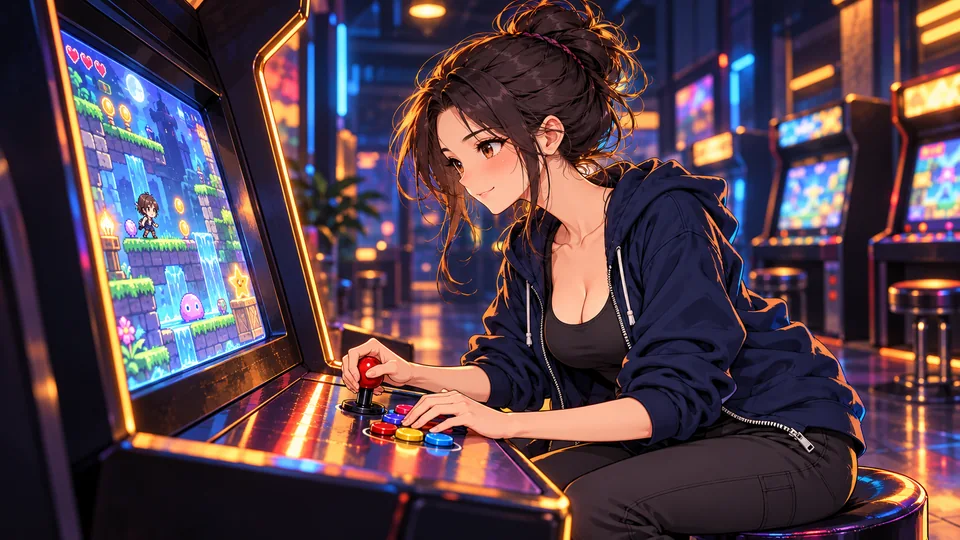
Vibe gaming in this material — creating your own games with AI and the life of these games in the community: coming up with an idea, building a prototype, playing, getting feedback, and releasing the next version. At the core of this process is vibe coding of games, when the author manages part of the development using natural language.
Usually, everything starts with a specific desire. You want a quiz for an evening with a loved one. Or a game about a queue, where someone says "just one question" again. Or a car market simulator that understands your chat's jokes. Such an idea needs rules, a first working version, and players who will honestly say what is interesting and what makes them want to close the tab.
In Vibe Coding, we are launching the vibe gaming direction around vibe coding games platform. We collect authors' works, giving them individual pages and a place for feedback. The goal is a short path from "I have an idea" to "try my game."
Vibe gaming, vibe-gaming, and vibe gaming: what does it mean
Vibe gaming in our context starts with creating a game using AI and continues after publication: other people play, describe their experience, and the author releases the next version. Writing "vibe-gaming", "vibe gaming" and the terms "vibe gaming" and "vibe-gaming" in this article refer to the same concept.
International formulation vibe gaming is already being applied to game creation through AI agent instructions. We are developing a Ukrainian environment of authors and players around this. In a broader internet context, these words may also refer to regular gaming channels or the mood of a game, so it is important to read the specific author's explanation.
What it means to vibe game, or vibe-game
To vibe-game — a colloquial way to say "creating and gradually refining a game together with AI." For example: "I want to vibe-game a card game for friends," "today we're going to vibe game a simple arcade." Players can contribute ideas and testing; the author makes the decisions regarding changes.
For the development process itself, we use the word "gamecoding", and for the action— "gamecoding". In the gamecoding dictionary forms like "game-coding," "game coding," and "vibe coding of games" are also explained. A detailed prompt-based creation route was left in that guide; here we analyze how a game for people grows from a prototype.
The vibe gaming cycle: idea, play, feedback, new version
- The author formulates an idea. Who would be interested in playing, what the player does, and what their goal is.
- Assembles a prototype together with AI. First, one mechanic and a full cycle with a restart.
- Publishes a clear version. Describes controls, supported devices, and known limitations.
- Players try it out and describe their experience. What is clear, what is boring, what broke, and on which device.
- The author chooses one change. Fixes the problem, checks previous scenarios, and updates the game.
This can be one evening or a long-term project. A useful sign of progress is a specific change in experience: people understood the start, stopped getting stuck, noticed a victory, or wanted to repeat it. The number of prompts and the amount of generated code do not show this by themselves.
What changes in game creation
Development consists of many decisions: how to move, what to collect, how collision works, when to increase difficulty. An AI assistant can prepare prototype code, explain an error, or suggest a mechanic variant. The author gets the opportunity to test the main thing earlier: whether the action is worth repeating.
This opens up space for small personal games. One might only take five minutes to make friends laugh. Another might become a trainer, a family quiz, or a long author project. The audience size and game complexity can vary; a completed gaming experience is valuable even in a small format.
However, the first generated version often only shows the direction. It might turn out that the hero moves unpleasantly, an enemy appears right in front of them, or victory changes nothing. Game design begins where the author notices these problems and decides what the next version should be.
Vibe gamer — someone who enjoys playing vibe-coded games. They discover new ideas, play, evaluate, and can help the author with feedback. A vibe gamer doesn't necessarily have to program or generate games themselves. If you have already created a game, here is how to publish it and share it with the world.
Vibe gaming, gamecoding, and standard gaming AI
| Concept | What we mean | Example |
|---|---|---|
| Vibe Coding of games | Working with code through AI tasks and result verification | Explain rules, get a prototype, describe a collision error |
| Gamecoding | Our short word for creative work on a game with AI | "Today I'm gamecoding a platformer." Separate explanation and practical route |
| Vibe gaming | In our context — creation, publication, play, and feedback exchange | The author showed a demo, players found a problem, a more interesting version was released |
| AI inside the game | Opponent behavior, NPC, or generation during gameplay itself | The opponent chooses a route; the character responds to a line |
A game created with the help of generative AI can function without it after launch. And vice versa: the presence of a smart opponent does not explain which tools the author used to write the game. Therefore, in the catalog, a short author's story about the process and tools is important.
What is already happening abroad
In Tripo Vibe Gaming Playbook formulation vibe gaming connects with controlling an agent for code using natural language and preparing 3D assets. This is an example of an instrumental route from idea to game. The specific set of services may vary.
Rosebud suggests starting game creation from a description or template. TryAIgame works as a catalog of AI-created game experiments. And VIBE GAMING publishes its own small browser games and describes the use of AI in their development.
Our focus is on Ukrainian authors, their ideas, and a clear opportunity to play. We are developing this environment into Vibe Coding: with individual pages for works, creation descriptions, and direct feedback.
Three Ukrainian ideas that are already visible
Solviq started with the author's desire to play intellectual trivia in Ukrainian with his wife. This is a good example of a task a person understands well from personal experience: sit down, open the questions, and spend an evening together.
"The Reseller" uses a different advantage: recognizable situations and humor from the Ukrainian car market. Buying, repairing, and reselling cars gain character through local context and community reactions.
"I'm just asking!" turns a familiar shop queue into a game situation. In all three cases, the initial idea is clear without listing models and technologies. Tools help implement it, and the author's perspective gives a reason to play.
Example: how to improve a game, not just add effects
Let's imagine "The Last Marshrutka": the hero runs to the stop, avoids obstacles, and tries to make it before departure. This is our fictional educational example, not a published catalog participant.
| Version | What we are checking | What decision the author makes |
|---|---|---|
| First prototype | Does it feel good to move and jump? | Change speed, jump duration, and button response |
| First obstacle | Is it clear why the player lost? | Show danger in advance and give time to react |
| First completed run | Is there tension before the stop? | Adjust distance and time buffer, make the victory noticeable |
| First third-party players | Where do people who don't know the concept get lost? | Simplify the start, explain controls, check the phone |
A useful task for AI after testing:
In the "Last Marshrutka" prototype, the character sometimes loses
as soon as an obstacle appears on the screen.
Make the appearance predictable and leave time for reaction.
Explain which values affect the difficulty.
Preserve controls, victory, loss, and restart.
Provide a short checklist after this change.
Here we have an observation, desired behavior, and the scope of the change. With such a prompt, it's easier to understand exactly what is being fixed. Adding a new effect makes sense when it enhances the experience: for example, a noticeable signal of an imminent departure.
How to start making a game with AI without experience
- Choose one action. Jump, hit, select a card, find a pair, or deliver an item.
- Write down the goal and the losing condition. The player must have a clear task.
- Build a minimum version. For a first browser experiment, you can ask for a single HTML; for a more complex project, a structured project will be needed.
- Go through the full cycle. Start, play, win or lose, retry. Check every transition.
- Show the result. Give short instructions and ask for specific feedback.
Practical tasks and tool selection are collected in a mini-course on Vibe Coding games. If you want to start with the smallest example, open the short guide "How to make a game with AI".
How an experienced developer can use this approach
For larger projects, it is convenient to give the AI limited tasks: a mechanics prototype, an editor tool, a state saving check, or an error explanation. Describe the contract: input data, expected result, files that can be modified, and testing scenarios.
Keep working versions in a version control system and check changes before merging. Resources from different sources require consistent scale, style, and usage rules. For the browser, separately check load size, controls, and behavior on the specified devices.
Where to play vibe coding games and publish your own
Open the Vibe Coding game catalog. Choose a genre or game direction, device, and format. The game has its own page; external projects open on the author's site. Read the control description and leave feedback after playing.
An author can submit several of their own games from one account: log in via email with a code, add an HTML/ZIP file or link, a cover, description, genre, and tools. After review, the work will appear in the catalog. Games outside the competition have player ratings; competition games keep their own official voting.
For the Vibe Jam separate rules apply, specifically the 2D requirement. The permanent platform also accepts 3D and Telegram projects. For large resources or games with their own server, use a link to a ready-to-run version.
How a player can help the author
Try a new game without the author's explanation and record one specific moment. Useful feedback has four parts: device → action → what happened → what was expected. For example: "Android, vertical screen. Pressed pause, then resume. The hero moves, but the jump button disappeared. Expected all buttons to return." This is a fictional sample formulation, not a bug found in a specific game.
Describe feelings separately: "I finished the first level, but didn't notice I had already won." The rating and voice show preference, while the explanation helps understand the reason. The author can verify the problem and give the AI a limited task with a clear expected result.
Questions about vibe gaming
Is this a separate genre of games?
In our direction, it is an approach to creating and sharing games. The genre itself can vary: strategy, puzzle, shooter, simulator, or platformer.
Can a game be created entirely without manual code?
For some small projects, it is possible. Checking, choosing mechanics, and explaining edits are still necessary. A more complex concept may require working with an engine, files, and technical limitations.
What to write to the author after playing?
What device you played on, what you liked, where you got stuck, and how to repeat the error. "The button disappears after the third restart" helps more than just "it doesn't work."
Are vibe gaming and vibe-gaming different directions?
In our article, these are variations of writing the same direction: games created with AI assistance and the interaction between authors and players. In other communities, the meaning of the word may be broader.
Is vibe-gaming just playing?
On our website, to vibe-game means to create and modify your own game together with AI. A person who only plays a finished game participates as a player and can help with feedback.
How does vibe gaming differ from gamecoding?
In our glossary, gamecoding describes working on a game. Vibe gaming also covers publishing, playing, discussion, and returning to the next version. These concepts are related and can describe the same project.
Game vibing worldwide: games, creators and real earnings stories →
Discussion
Share your opinion or ask about the material. Your nickname and comment text will be visible to everyone.
Log in via email
Get a one-time code. No password required.
The code is valid for 10 minutes. Logging in does not subscribe you to the newsletter. Data usage.
Or log in via ChatGPT ↗Loading comments...