PRACTICE · CAD · 3D · MANUFACTURING
AI for CAD and engineering: what already works and what still needs human review
OpenAI has shown how models can assist with CAD, circuit boards, simulations and manufacturing preparation. The important conclusion is not that AI has replaced engineers: the prototypes still needed several review cycles for tolerances, assembly and manufacturing constraints. Here is what can be delegated today and how to avoid missing errors in a polished model.
What OpenAI actually demonstrated
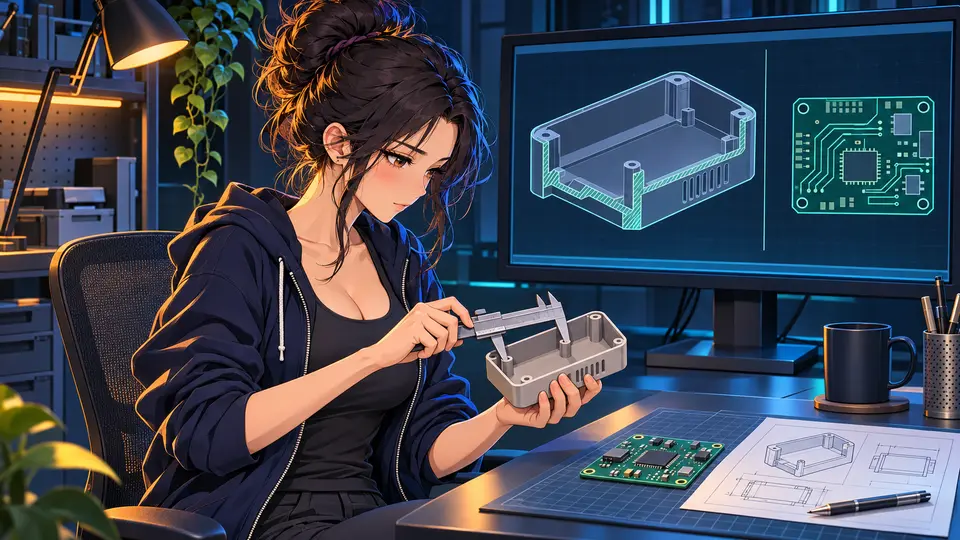
In the test, GPT‑6 defined the device requirements while Astra helped design the enclosure, PCB, interface and software integrations. Two team members produced the design in under a week as a side project, and a contract manufacturer built a small prototype batch in under a month.
This is the company’s account of one internal test, not an independent comparison with a conventional team. It does not disclose the full cost, failed iterations or human hours saved.
Several review cycles were still needed before manufacturing: the model did not consistently account for production limits, tolerances and assembly details. That gap separates plausible geometry from a manufacturable product.
Where AI is already useful in 3D and engineering workflows
The report names concrete tasks: creating and revising CAD models, preparing 2D manufacturing drawings, setting up simulations, reviewing designs and coordinating changes across mechanical, electrical and software work.
Chip Ganassi Racing is testing workflows that turn 3D scans into editable CAD models and drawings, with its engineers checking accuracy and manufacturability. Mazda is separately exploring aerodynamics and crash safety; OpenAI says results will come later, so this is a collaboration rather than proven time or cost savings.
OpenAI also reports a 23-fold increase in model use across its hardware teams, measured in tokens. That shows usage intensity; it does not mean work became 23 times faster.
Why BenchCAD is not a percentage of production-ready parts
BenchCAD 2.0 tests reconstruction of 3D parts and assemblies and identification of circuit-board connections. OpenAI reports an average score of 0.875 for a newer internal model versus 0.594 for GPT‑6 Astra at its highest reasoning setting.
That is an evaluation score, not 87.5% safe parts, successful manufacturing runs or budget savings. A real product adds materials, loads, process limits, supply constraints, regulation and accountability.
A safer workflow: AI drafts, humans decide
Do not start with “design everything.” Start with a task contract: input files, units, coordinate system, material, critical surfaces, manufacturing process and acceptance criteria. If a parameter is unknown, the model should ask or record an assumption.
Keep the editable native file, not only a polished render or STL. Compare versions, inspect the feature tree and exports, and separate simulation from geometry: FEA or CFD results depend on the mesh, boundary conditions and material model.
Before release, use an independent checklist: dimensions and units, collisions, minimum wall thickness, tolerances, tool access, assembly, BOM, revision names and responsible sign-off. Safety-critical products have industry procedures that this guide does not replace.
Local brief for the first review
Fill in only what you know. The brief is generated in your browser: the project name, constraints and text are not sent to the server. Analytics records only that a brief was generated, copied or downloaded, never the entered values.
Takeaway for a 3D specialist or small team
The shortest realistic test is one bounded task: reconstruct a simple part from a scan, prepare a drawing from an approved model or draft a review checklist. Compare time and corrections with your normal workflow; one successful example does not prove universal acceleration.
A realistic product for the Ukrainian market is not “AI will design anything,” but a reviewable package: an input brief, editable file, assumption log and checklist before handoff to an engineer or manufacturer. We have not yet confirmed paid demand or pricing for such a package.
Quick answers
Can AI independently produce a manufacturing-ready part?
In the reported test, AI assisted across many stages, but several human review cycles were still needed before manufacturing. Specialists remain responsible for tolerances, materials, safety and acceptance.
Does a 0.875 score prove the model is almost error-free?
No. It is an average BenchCAD 2.0 score for a newer internal model, not the share of safe products or successful manufacturing runs.
What should a 3D specialist try first?
Choose one non-critical, verifiable subtask: simple reconstruction, a drawing from an approved model or a review checklist. Keep the source files and record your own time and corrections.
Discussion
Share a thought or ask about the article. Your nickname and comment will be public.
Sign in with email
Get a one-time code. No password needed.
The code expires in 10 minutes. Signing in does not subscribe you to the newsletter. Data use.
Or sign in with ChatGPT ↗Loading comments…